

 +86-18615202650
 Home > Product > Angular Contact Ball Bearing
Angular Contact Ball Bearing
Angular contact ball bearings have raceways on both the inner and outer rings, and the inner and outer rings can move relative to each other along the bearing axis. This type of bearing is particularly suitable for bearing compound loads, that is, loads acting radially and axially at the same time. The axial load bearing capacity of angular contact ball bearings increases with the increase of the contact angle α. The contact angle is the angle between the line connecting the contact points of the ball and the raceway in the radial plane and the perpendicular line to the bearing axis.
Design and variation
Product details
511 Results
| Model number | Basic size | Basic load rating | Rated speed | ||||
|---|---|---|---|---|---|---|---|
| Dynamic state | Static | Reference speed | Limiting speed | ||||
| d [mm] | D [mm] | B [mm] | C [kN] | C₀ [kN] | [r/min] | [r/min] | |
|
QJ206
|
30 | 62 | 16 | 37.5 | 30.5 | 19000 | |
|
7340BCBM
|
200 | 420 | 80 | 462 | 655 | 1900 | 2200 |
|
7410 B
|
50 | 130 | 31 | 95.6 | 64 | 7000 | 9000 |
|
7414 B/DT
|
70 | 180 | 42 | 159 | 127 | 4800 | 6300 |
|
7260
|
300 | 540 | 85 | 553 | 930 | 1300 | |
|
3306A/C3
|
30 | 72 | 30.2 | 42.5 | 30 | 6300 | |
|
3208ATN9
|
40 | 80 | 30.2 | 48 | 36.5 | 9000 | 8000 |
|
5313
|
65 | 140 | 58.7 | 142 | 113 | 3200 | 4300 |
|
5308AH/C3
|
40 | 90 | 36.5 | 65.5 | 48 | 6700 | 5000 |
|
BA2-0031
|
35 | 37 | 30 | 242 | 268 | 10000 | |
|
BA2B246033B
|
30 | 60 | 37 | 8000 | 10000 | ||
|
BA2B309609AD
|
42 | 80 | 42 | 3400 | 4500 | ||
| Model number | Basic size | Basic load rating | Rated speed | ||||
|---|---|---|---|---|---|---|---|
| Dynamic state | Static | Reference speed | Limiting speed | ||||
| d [in] | D [in] | B [in] | C [Ibf] | C₀ [Ibf] | [r/min] | [r/min] | |
|
QJ206
|
19000 | ||||||
|
7340BCBM
|
1900 | 2200 | |||||
|
7410 B
|
7000 | 9000 | |||||
|
7414 B/DT
|
4800 | 6300 | |||||
|
7260
|
1300 | ||||||
|
3306A/C3
|
6300 | ||||||
|
3208ATN9
|
9000 | 8000 | |||||
|
5313
|
3200 | 4300 | |||||
|
5308AH/C3
|
6700 | 5000 | |||||
|
BA2-0031
|
10000 | ||||||
|
BA2B246033B
|
8000 | 10000 | |||||
|
BA2B309609AD
|
3400 | 4500 | |||||
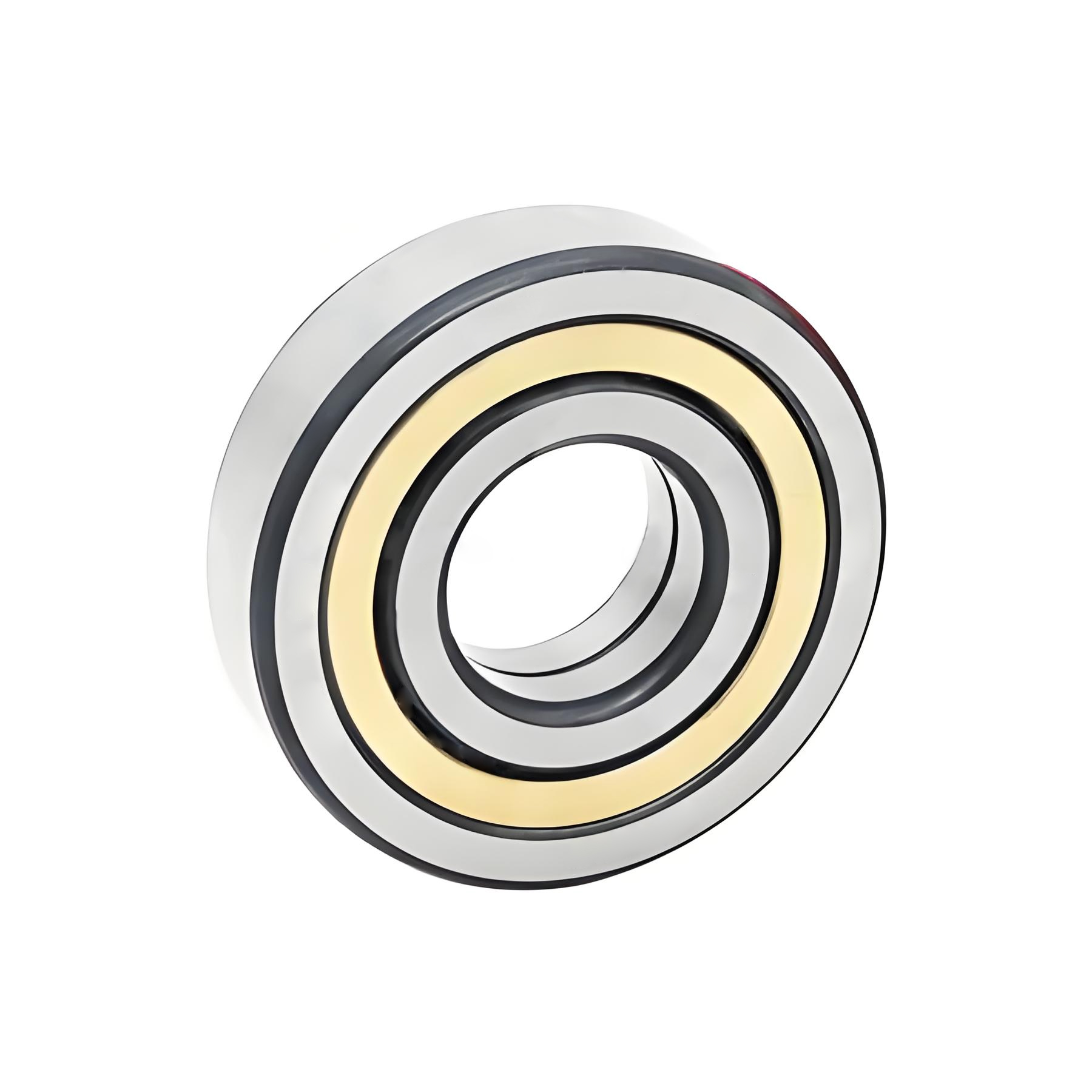
Four-point Contact Ball Bearings
This is a single-row angular contact ball bearing with separated inner and outer rings. The inner ring is divided into two parts. It can withstand axial loads in two directions and is suitable for occasions with large pure axial loads or combined loads.
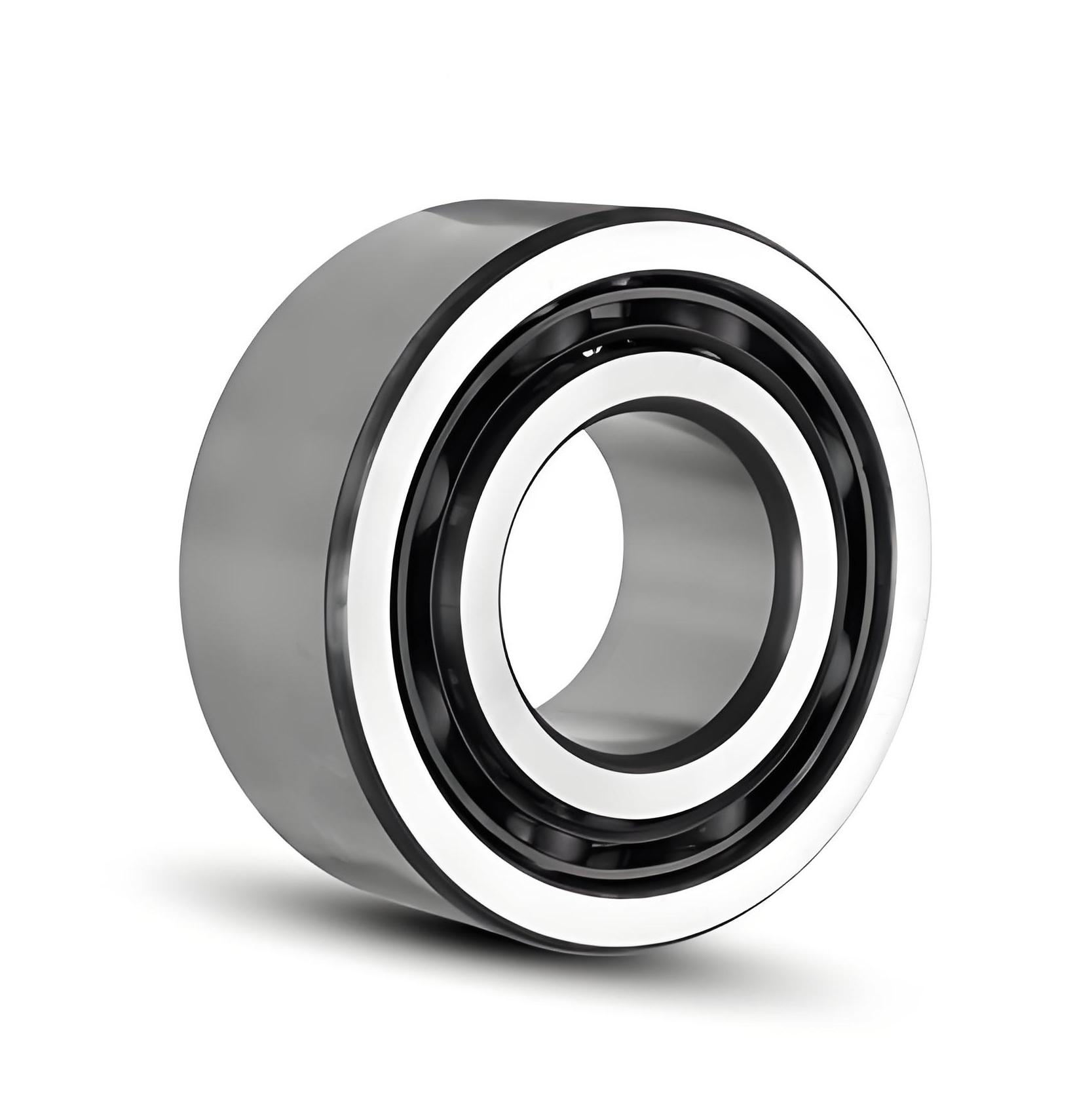
Double Row Angular Contact Ball Bearings
Double-row angular contact ball bearings have a double-row ball structure, occupying less axial space and can withstand bidirectional axial displacement and overturning moment.
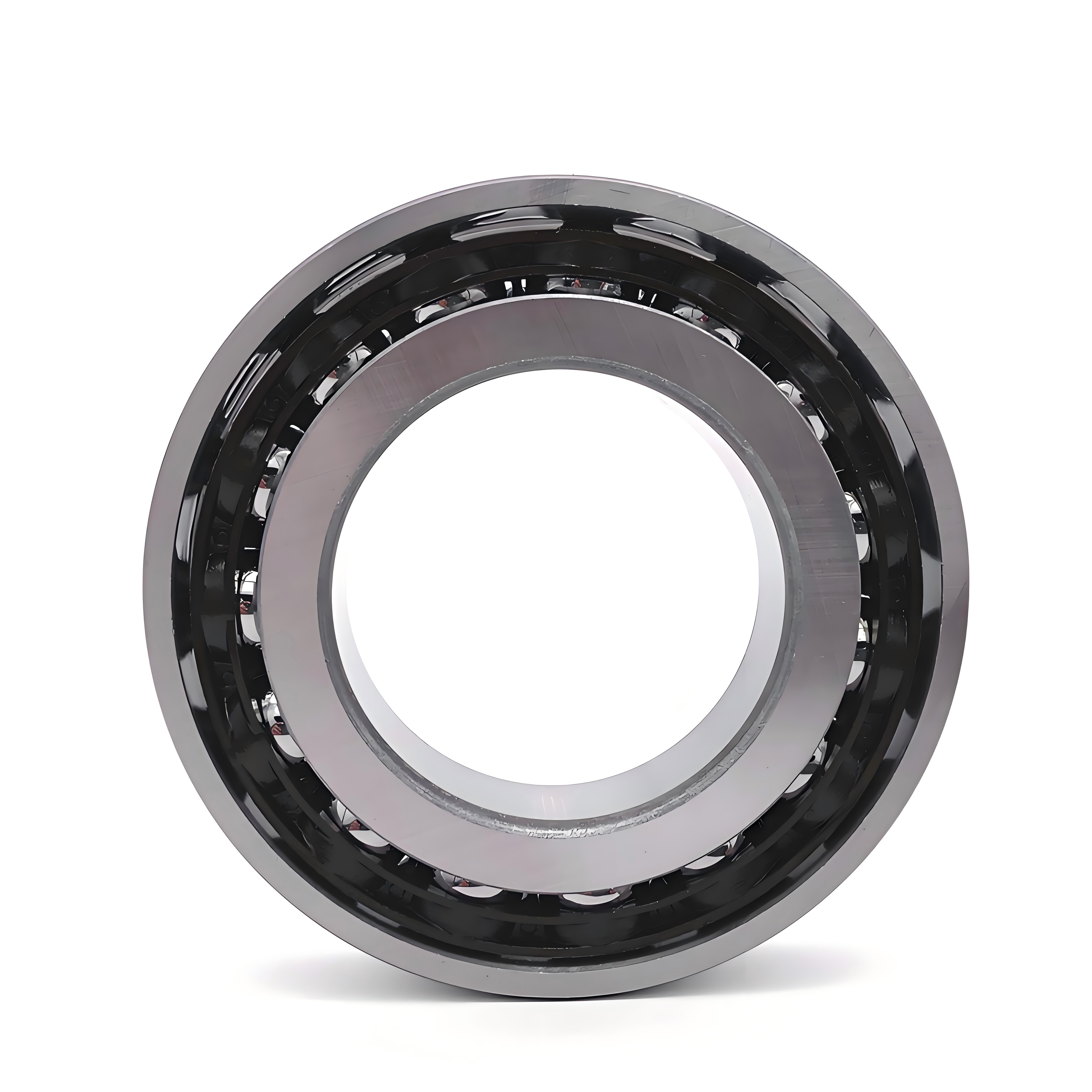
Single Row Angular Contact Ball Bearings
Single row angular contact ball bearings include 718, 719, 70, 72, 73 and other series. These bearings can withstand unidirectional axial and radial forces. The contact angles are 15° (suffix C), 25° (suffix AC), 30° (suffix A) and 40° (suffix B). The larger the contact angle, the stronger the axial load bearing capacity, but the speed will be relatively slow.
Angular Contact Ball Bearings: The Precision Choice for High-Speed Combined Loading
Angular Contact Ball Bearings Feature
1. Bidirectional load capacity: Angular contact ball bearings can bear radial loads and axial loads at the same time. This bidirectional load capacity makes it widely used in the field of industrial machinery, such as machine tool spindles, automobile wheel hubs, motor rotors, etc.
2. High-speed operation: Angular contact ball bearings can operate at higher speeds. The larger the contact angle, the higher the axial load capacity, and the smaller the contact angle, the more suitable it is for high-speed rotation.
3. Paired installation:
Since single-row angular contact ball bearings can only bear axial loads in one direction, they are usually installed in pairs, with back-to-back and face-to-face forms. Paired bearings can withstand bidirectional axial loads.
4. Preload effect:
Preload is one of the important factors that determine the performance of angular contact ball bearings. The larger the preload, the higher the radial stiffness and axial stiffness, but the heat generation increases and the limit speed decreases. Excessive preload may cause sticking during high-speed operation.
5. Combination use: Angular contact ball bearings can be used in combination. Common combinations include back-to-back combination (DB), face-to-face combination (DF) and series combination (DT). Combination use can provide higher rigidity and load capacity, but the maximum speed will be reduced.
Application
Angular contact ball bearings are widely used in high-frequency motors, centrifugal separators, small car front wheels, oil pumps, Roots blowers, air compressors and other equipment.
FAQ
Q1: Can angular contact ball bearings handle pure axial loads?
A: Yes, but they must be paired or use four-point contact design. Single-row bearings can handle pure axial loads only in the direction of the contact angle. For bidirectional pure axial loads, use back-to-back or face-to-face pairs, or a four-point contact bearing (QJ series).
Q2: Why must angular contact bearings be used in pairs or preloaded?
A: The contact angle creates an axial force component even under pure radial loads. A single bearing would separate under load. Pairing (DB, DF, DT) cancels internal forces and provides stability. Preload eliminates internal clearance, maximizing rigidity and preventing ball skidding at high speeds.
Q3: What's the difference between 15°, 25°, and 40° contact angles?
A: 15° (C): Highest speed, lowest axial capacity, for light thrust loads. 25° (AC): Balanced performance, most versatile, for moderate combined loads. 40° (B): Maximum axial capacity, lowest speed, for heavy thrust applications like gearboxes.
Q4: Can I mix different brands in a bearing pair?
A: Not recommended. Duplex pairs must have identical internal geometry, preload, and offset grinding. Mixing brands can cause different thermal expansion, cage materials, and internal clearances, leading to premature failure. Always use factory-matched pairs from the same manufacturer.